EKF Failsafe
The EKF failsafe monitors the health of EKF (the position and attitude estimation system) to catch problems with the vehicle’s position estimate (often caused by GPS glitches or compass errors) and prevent the vehicle driving off course under autonomous control.
When will it trigger?
The EKF failsafe will trigger when any two of the EKF “variances” for compass, position or velocity are higher than the FS_EKF_THRESH parameter value for 1 second.
These “variances” come from the EKF itself and are numbers indicating the EKF’s confidence in its estimates. The values are between 0 and 1 with 0 meaning the estimate is very trustworthy and 1.0 is very untrustworthy.
The EKF calculates these “variances” by comparing the results from multiple sensors. So for example, if the GPS position suddenly jumps but the accelerometers do not show a sudden acceleration, the EKF variance for position would climb (i.e become less trustworthy)
The check only runs while the vehicle is armed.
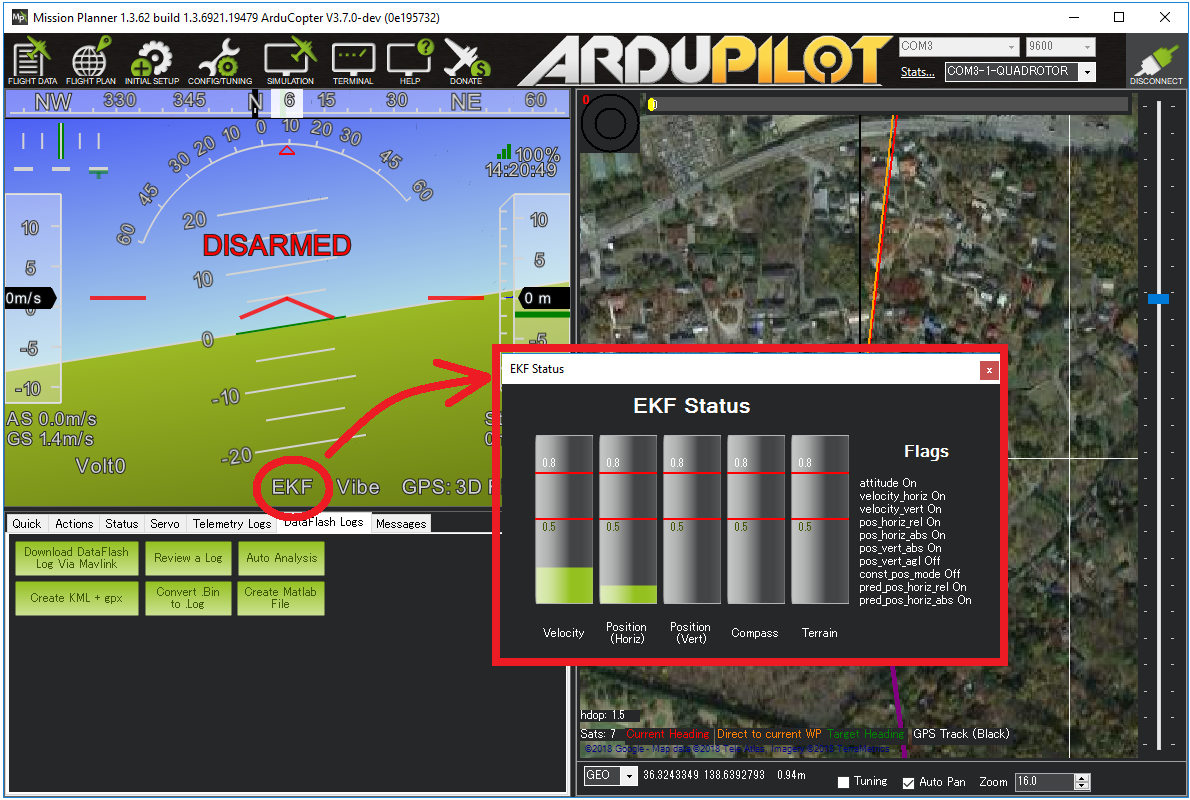
The variances can be viewed in real-time on the ground station. If using Mission Planner click on the “EKF” label on the HUD.
What will happen when the failsafe triggers?
The autopilot’s LED will flash red-yellow or blue-yellow and the tone-alarm will sound
“EKF variance” will appear on the ground station’s HUD if telemetry is connected
An EKF failsafe error will be written to the dataflash logs
In modes that do not require a position estimate (i.e. Manual, Acro, Steering, Hold) nothing further will happen, but the vehicle cannot be switched into a mode that requires position (Auto, Guided, RTL, SmartRTL, Loiter, Follow, Dock, Circle) until the failure clears
In modes that require a position estimate the FS_EKF_ACTION parameter controls the behaviour. By default this is “1” meaning the vehicle will switch to Hold mode and stop. The other options are “0” to disable the failsafe entirely and “2” to report the failure to the ground station without changing mode
After an EKF failsafe occurs, the driver can re-take control (using the mode switch) in Manual mode to drive the vehicle home.
Adjusting the Sensitivity of the failsafe
The FS_EKF_THRESH parameter can be adjusted to control the sensitivity of the failsafe
Set FS_EKF_THRESH = 0 to disable the EKF failsafe
Increase FS_EKF_THRESH to values between 0.8 and 1.0 to reduce the chance of an EKF failsafe. The downside of increasing this parameter value is that when the position estimate is bad the vehicle will travel further off course before it is automatically switched to HOLD
Decrease FS_EKF_THRESH to values as low as 0.6 to increase the chance of an EKF failsafe triggering quickly. The downside of lowering this value is the EKF failsafe could stop the vehicle unnecessarily, for example during hard turns or over rough ground
EKF’s Glitch Protection
The EKF’s glitch protection works as follows:
When new GPS position and velocity measurements are received, they are compared to a position predicted using IMU measurements.
If the position difference exceeds a statistical confidence level set by EK3_POS_I_GATE then the measurement won’t be used. Similarly the velocity is checked using EK3_VEL_I_GATE.
If the GPS glitch lasts long enough (usually about 7 seconds), the EKF’s position and velocity estimates will be reset to the GPS position and velocity.
EK3_GLITCH_RAD controls the maximum radial uncertainty in position between the value predicted by the filter and the value measured by the GPS before the filter position and velocity states are reset to the GPS. Making this value larger allows the filter to ignore larger GPS glitches but also means that non-GPS errors such as IMU and compass can create a larger error in position before the filter is forced back to the GPS position. If EK3_GLITCH_RAD set to 0 the GPS innovations will be clipped instead of rejected if they exceed the gate size set by EK3_VEL_I_GATE and EK3_POS_I_GATE which can be useful if poor quality sensor data is causing GPS rejection and loss of navigation but does make the EKF more susceptible to GPS glitches. If setting EK3_GLITCH_RAD to 0 it is recommended to reduce EK3_VEL_I_GATE and EK3_POS_I_GATE to 300