ZeroOneX6 Air/Air+
The ZeroOneX6_Air/Air+ is a series of flight controllers manufactured by ZeroOne , which is based on the open-source FMU v6C architecture and Pixhawk Autopilot Bus open source specifications.
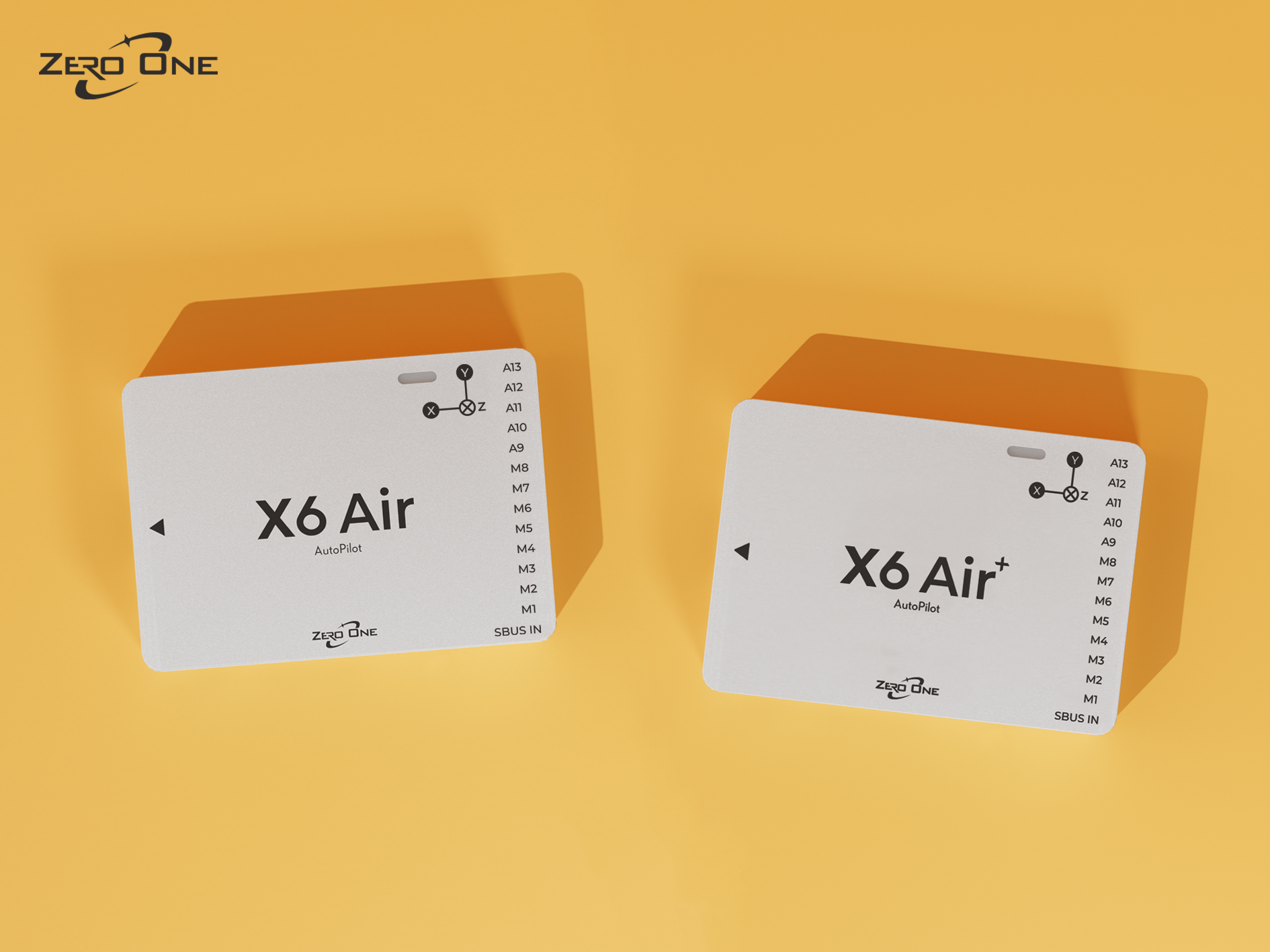
Features:
- MCU
STM32H743IIK6 32-bit processor running at 400MHz
2MB Flash
1MB RAM
microSD card interface
Safety Switch /LED
2x CAN
6x UART, one with RTS/CTS
2x I2C
2x ADC inputs
- IO MCU
STM32F103
Air’s Sensors * IMU: ICM45686 * Baro: ICP20100 * Magnetometer: IST8310
Air+ Sensors * IMU1: ICM45686 (With vibration isolation) * IMU2- ICM45686 (No vibration isolation) * IMU constant temperature heating (1W heating power) * Baros: 2 x ICP20100 (V1) * V2: SPL06 and BMP581 baros * Magnetometer: IST8310 magnetometer
Pinout
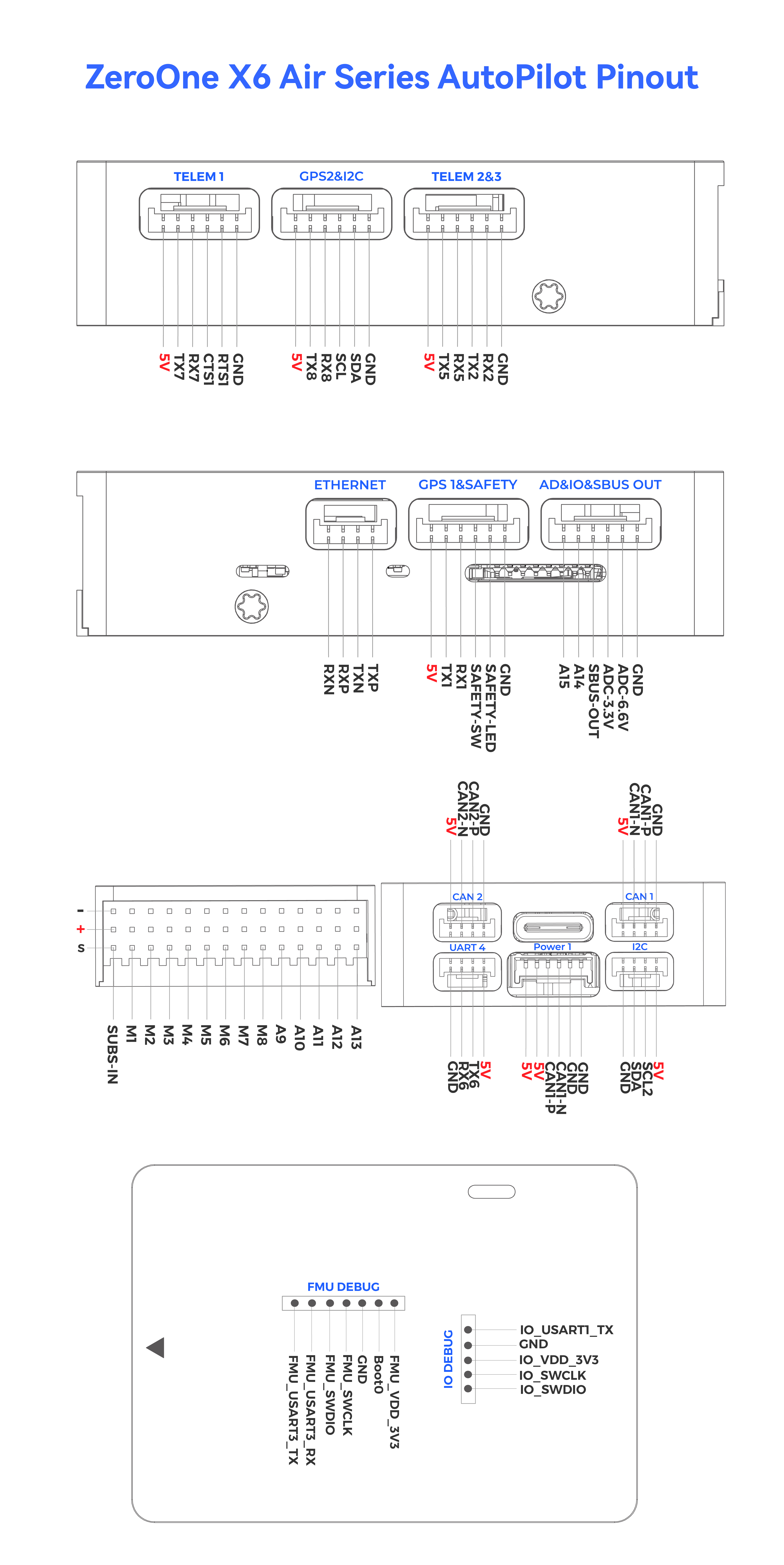
UART Mapping
- The UARTs are marked Rn and Tn in the above pinouts. The Rn pin is the receive pin for UARTn. The Tn pin is the transmit pin for UARTn.
Name
Function
MCU PINS
DMA
SERIAL0
OTG1
USB
SERIAL1
Telem1
UART7
DMA Enabled
SERIAL2
Telem2
UART5
DMA Enabled
SERIAL3
GPS1
UART1
DMA Enabled
SERIAL4
GPS2
UART8
DMA Enabled
SERIAL5
Telem3
UART2
DMA Enabled
SERIAL6
User
UART4
DMA Enabled
SERIAL7
Debug
UART3
DMA Enabled
SERIAL8
OTG-SLCAN
USB
RC Input
The SBUS pin, can be used for all ArduPilot supported receiver protocols, except CRSF/ELRS and SRXL2 which require a true UART connection. However, FPort, when connected in this manner, will only provide RC without telemetry.
To allow CRSF and embedded telemetry available in Fport, CRSF, and SRXL2 receivers, a full UART, such as SERIAL6 (UART4) would need to be used for receiver connections. Below are setups using Serial6.
SERIAL6_PROTOCOL should be set to “23”.
FPort would require SERIAL6_OPTIONS be set to “15”.
CRSF/ELRS would require SERIAL6_OPTIONS be set to “0”.
SRXL2 would require SERIAL6_OPTIONS be set to “4” and connects only the TX pin.
Any UART can be used for RC system connections in ArduPilot also, and is compatible with all protocols except PPM. See Radio Control Systems for details.
PWM Output
The X6_Air flight controller supports up to 15 PWM outputs.The first 8 outputs (labelled M1 to M8) are controlled by a dedicated STM32F103 IO controller. The remaining 7 outputs (labelled A9 to A15) are the “auxiliary” outputs. These are directly attached to the STM32H753 FMU controller.
All 15 outputs support normal PWM output formats. All outputs support DShot, except A15. Outputs 1-12 support Bi_Directional DShot.
The M1-8 outputs are in 4 groups:
Outputs 1 and 2 in group1
Outputs 3 and 4 in group2
Outputs 5, 6, 7 and 8 in group3
The A9-15 outputs are in 4 groups:
Outputs 9 - 12 in group1
Outputs 13 and 14 in group2
Outputs 15 in group3
Channels within the same group need to use the same output rate. If any channel in a group uses DShot then all channels in the group need to use DShot.
GPIO
All PWM outputs can be used as GPIOs (relays, camera, RPM etc). To use them you need to set the output’s SERVOx_FUNCTION to -1. The numbering of the GPIOs for PIN variables in ArduPilot is:
Name
Value
Name
Value
M1
101
A9
50
M2
102
A10
51
M3
103
A11
52
M4
104
A12
53
M5
105
A13
54
M6
106
A14
55
M7
107
A15
56
M8
108
Battery Monitoring
The X6_Air flight controller has one six-pin power connector, supporting a CAN interface power supply on CAN bus 1.
The autopilot defaults are setup for CAN Power Module use (normally supplied with autopilot):
BATT_MONITOR = 8
CAN_P1_DRIVER = 1
CAN_D1_PROTOCOL = 1
Compass
The X6_Air flight controller has a built-in industrial-grade electronic compass chip IST8310. Due to potential interference, the autopilot is usually used with an external I2C compass as part of a GPS/Compass combination.
Analog inputs
The X6_Air flight controller has 2 analog inputs.
ADC Pin12 -> ADC 6.6V Sense
ADC Pin13 -> ADC 3.3V Sense
Loading Firmware
The board comes pre-installed with an ArduPilot compatible bootloader, allowing the loading of xxxxxx.apj firmware files with any ArduPilot compatible ground station.
Firmware for these boards can be found here in sub-folders labeled “ZeroOne_Air”.