Installing Mission Planner
Mission Planner was designed for native Windows installation. However, it is possible to use it under Linux (with some occasional issues) and there is a Beta version for Android OS.
Windows Installation
The following instructions show how to install Mission Planner on Windows. These instructions will be suitable for most users. For advanced users and non-standard installations, instructions are found here:. A useful video guide for advanced installation of Mission Planner is located here.
Download the latest Mission Planner installer from here
Double click on the downloaded .msi file to run the installer
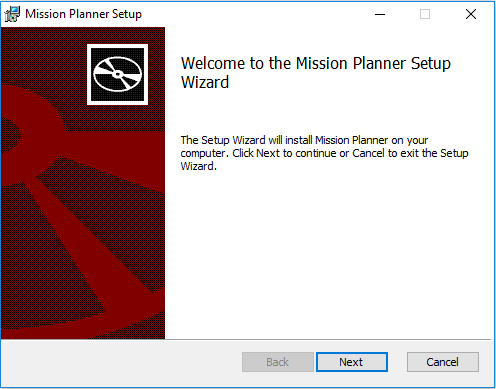
Follow the instructions to complete the setup process. The installation utility will automatically install any necessary software drivers. If you receive a DirectX installation error, please update your DirectX plug-in from the Windows Download Center.
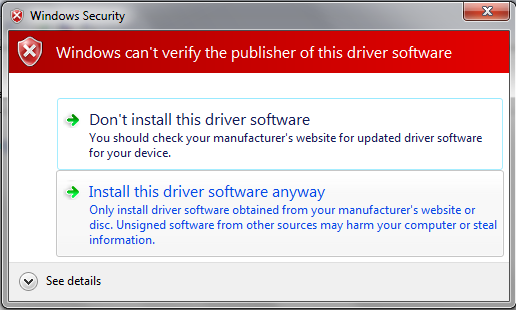
If you receive the warning pictured below, select Install this driver software anyway to continue.

Mission Planner is normally installed in the C:\Program Files (x86)\Mission Planner folder.
An icon to open the Mission Planner is created according to your instructions during the installation.
Open Mission Planner
Once installation is complete, open Mission Planner by clicking on its system icon.
Then you can either:
Connect Mission Planner to AutoPilot in order to receive telemetry and control the vehicle OR
Updating Mission Planner
Mission Planner automatically notifies you about available updates (when it is connected to the Internet).
Please always run the most current version of Mission Planner.
Mission Planner on Android
A version for Android is in development and can be downloaded from the Google Play Store here.
The latest version is also available here. Download to device, and double click on it to install.
Mission Planner on macOS
There is no stable release of Mission Planner for macOS. The options are:
Run the Windows version in a virtual machine (recommended). Install Windows using Parallels Desktop, VMware Fusion or UTM, then install Mission Planner in Windows as described above. On Intel Macs, Boot Camp can also be used. You may need to pass the autopilot’s USB connection through to the virtual machine.
Native macOS development build (experimental). A
.dmgbuilt from the latest Mission Planner code is available here. It is not recommended for inexperienced users, and not all features work. If macOS refuses to open it because the developer cannot be verified, allow it in System Settings > Privacy & Security.
QGroundControl and MAVProxy also run on macOS (see Choosing a Ground Station).
Mission Planner on Linux
Mission Planner does run on Linux, but will have occasional issues and/or crashes, and not all functions are available. QGC and MAVProxy are alternatives that run stably in Linux, but if Mission Planner is really desired, there are two ways to run it.
Linux development build
A Linux build of Mission Planner for x86_64 PCs is available. It needs the Mono runtime, but no SDK or compiler. On Ubuntu 22.04 or later, or Debian 11 or later:
Download
MissionPlanner-linux-x86_64.tar.gzfrom the Linux development release.Install the runtime packages, extract the archive and run it:
sudo apt update
sudo apt install mono-runtime libgdiplus fonts-dejavu-core \
  libmono-system-windows-forms4.0-cil libmono-system-web-extensions4.0-cil \
  libmono-system-management4.0-cil libmono-system-servicemodel4.0a-cil \
  libmono-system-data-entity4.0-cil libmono-system-net-http4.0-cil \
  libgl1 libgl1-mesa-dri
tar -xzf MissionPlanner-linux-x86_64.tar.gz
./MissionPlanner-linux-x86_64/run.sh
On Ubuntu 22.04/24.04 and Debian 11-13, also install
ca-certificates-mono(sudo apt install ca-certificates-mono). On newer releases it no longer exists, and thelibmono-system-*packages are provided bymono-libraries.To connect over USB or serial, your user needs access to the port, which usually means being in the
dialoutgroup (sudo usermod -aG dialout $USER, then log out and back in).To update, download and extract a new archive.
Other distributions need the equivalent Mono 6.8 or later packages. See the Mission Planner Linux README for details and for building it from source.
Windows version under Mono
The Windows version of Mission Planner can also be run using Mono:
Download and install the latest version of MONO from here
Download Mission Planner as a zip file from here and unzip to a directory.
Change to that directory and execute:
mono MissionPlanner.exe
Note
Zorin OS users: If you see errors with .exe files during build, run:
sudo apt install mono-complete