What is ArduPilot?
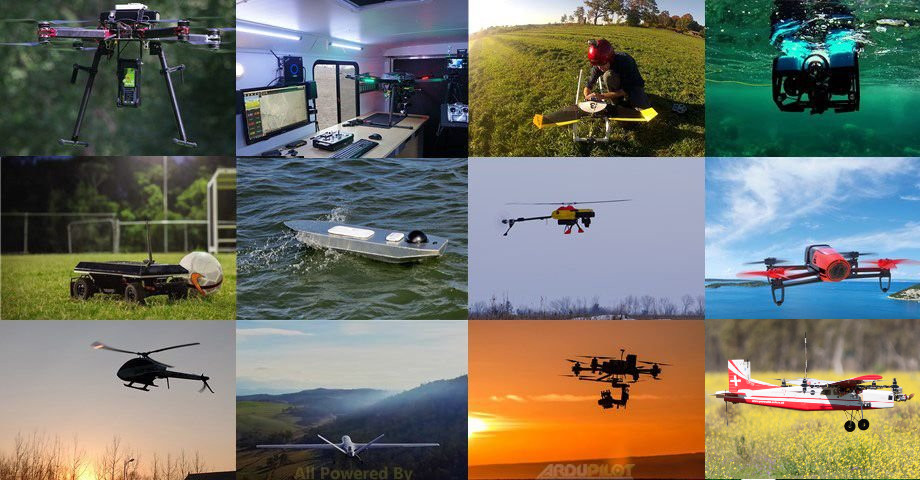
ArduPilot is a trusted, versatile, and open source autopilot system supporting many vehicle types: multi-copters, traditional helicopters, fixed wing aircraft, boats, submarines, rovers and more. The source code is developed by a large community of professionals and enthusiasts. New developers are always welcome! The best way to start is by joining the Developer Team Forum, which is open to all and chock-full of daily development goodness.
Who Uses ArduPilot?
The same firmware serves commercial operators, hobbyists and researchers. What differs is which parts of it they use, and how much of it they customize.
Commercial and Industrial Operators
ArduPilot is the autopilot behind a great many commercial vehicles and services. Typical applications include:
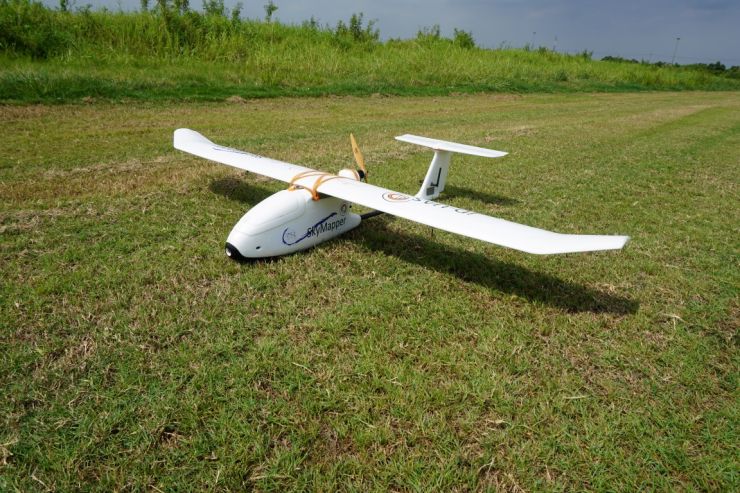
- Aerial mapping, photogrammetry and LiDAR survey, including stockpile volume measurement for mining and construction
- Inspection of power lines, wind turbines, solar farms, bridges, pipelines and other infrastructure
- Agriculture: crop scouting and multispectral imaging, spraying, spreading and livestock monitoring
- Public safety: search and rescue, firefighting support, disaster assessment and police observation
- Security and perimeter patrol, including docking stations and repeated scheduled missions
- Cargo delivery and long range, beyond visual line of sight transport
- Professional cinematography and broadcast, using stabilized gimbals and precise camera control
- Hydrographic and bathymetric survey, water sampling and harbour work with autonomous surface vessels
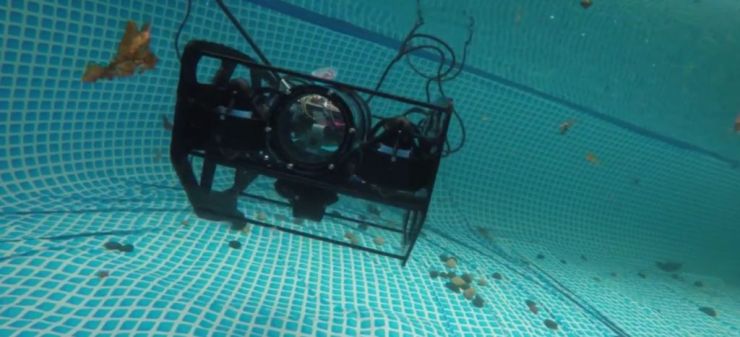
- Subsea inspection of hulls, dams, pipelines and aquaculture pens with ROVs
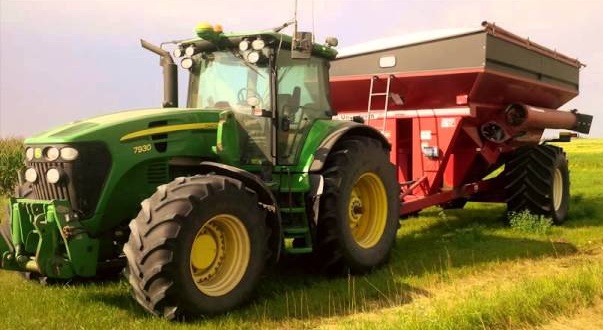
- Autonomous ground vehicles for mowing, agriculture, site logistics and materials handling
- Environmental and wildlife monitoring, anti-poaching patrols and atmospheric sampling
- Antenna tracking, to keep long range video and telemetry links pointed at the vehicle
The reasons given for choosing ArduPilot over a closed autopilot are usually:
- No licence fees and no vendor lock-in. The source is available under the GPLv3 licence, so a fleet can be supported for its whole working life regardless of what any one supplier does.
- Maturity. More than fifteen years of development and flight testing, with extensive failsafes, EKF state estimation, and support for redundant sensors, multiple GPS units and CAN peripherals.
- Hardware choice. Dozens of autopilot boards and peripherals from many vendors run the same firmware, so a supply problem with one component does not ground a fleet.
- Customization without forking. Lua scripting, custom firmware builds, and MAVLink or ROS 2 interfaces to a companion computer cover most needs without maintaining a private branch.
- Support is available. ArduPilot Partners fund the project's development, and a number of companies offer commercial support.
Hobby and Sport RC
The largest group of users by number: RC pilots and makers who want more from a model than manual control.
- Making a model easier and safer to operate, with stabilization, altitude and position hold, automatic takeoff and landing, and failsafes such as return-to-launch if the transmitter signal is lost or the battery runs low.
- Flying autonomous missions, aerial photography and FPV, planned and monitored from a ground station over a telemetry link.
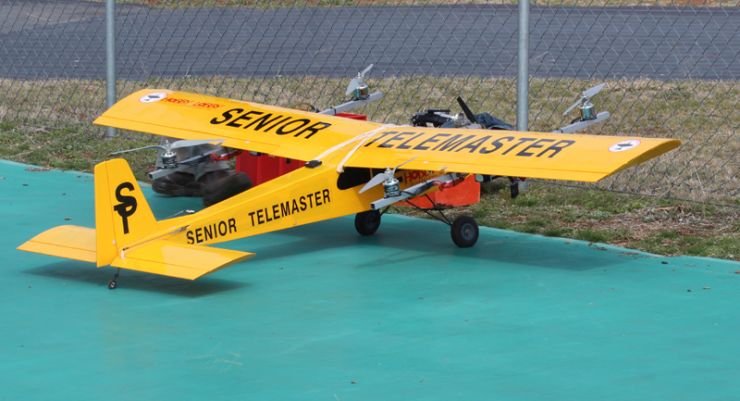
- Building unusual vehicles. Multicopters, fixed wing, quadplanes and tailsitters, traditional helicopters, boats, rovers, submarines, blimps and antenna trackers are all supported by the same codebase, including airframes that no commercial autopilot offers.
- Tinkering. Every parameter is exposed, every flight is logged in detail for later analysis, and Lua scripting allows new behaviour to be added without modifying the firmware.
Education and Research
Universities, schools and research institutes use ArduPilot as a ready made, well tested vehicle platform so that their effort goes into their own work rather than into writing an autopilot.
- A stable base for research into guidance, navigation and control, autonomy, swarming, computer vision, SLAM and machine learning, with a companion computer driving the vehicle over MAVLink or ROS 2.
- SITL simulation runs the real flight code on a desktop machine, so a whole class can fly, crash and try again without hardware, and experiments can be repeated exactly.
- Full source code and complete onboard logs mean results can be inspected, reproduced and published, with nothing hidden inside a proprietary binary.
- A common platform for student competitions and teaching, with a large community to ask when something does not behave as expected.
Community
Community is what really sets ArduPilot apart from many other offerings in the market. Here are some of the places you can find ArduPilot users and developers:
Latest posts on Community Blogs
Latest Community Forums posts
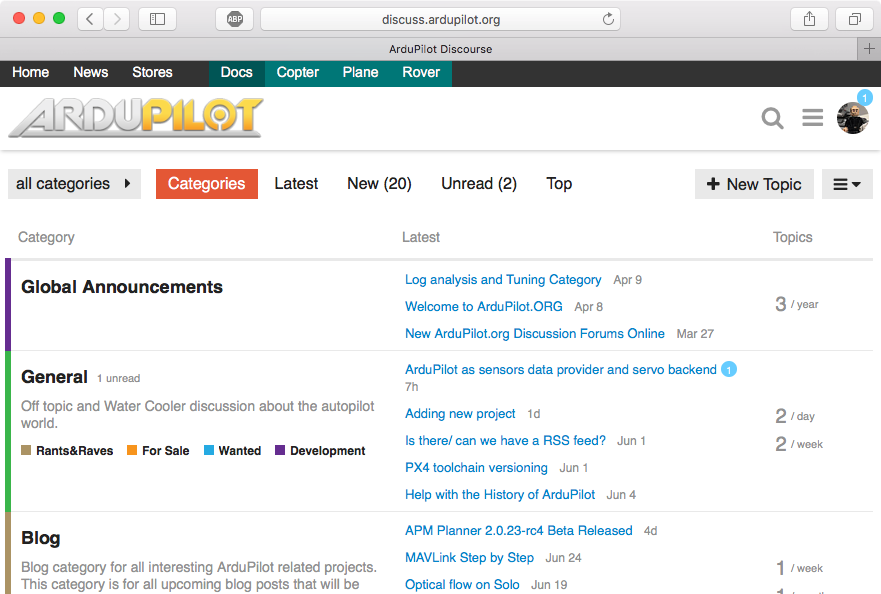
Discussion Forum
Facebook ArduPilot Group
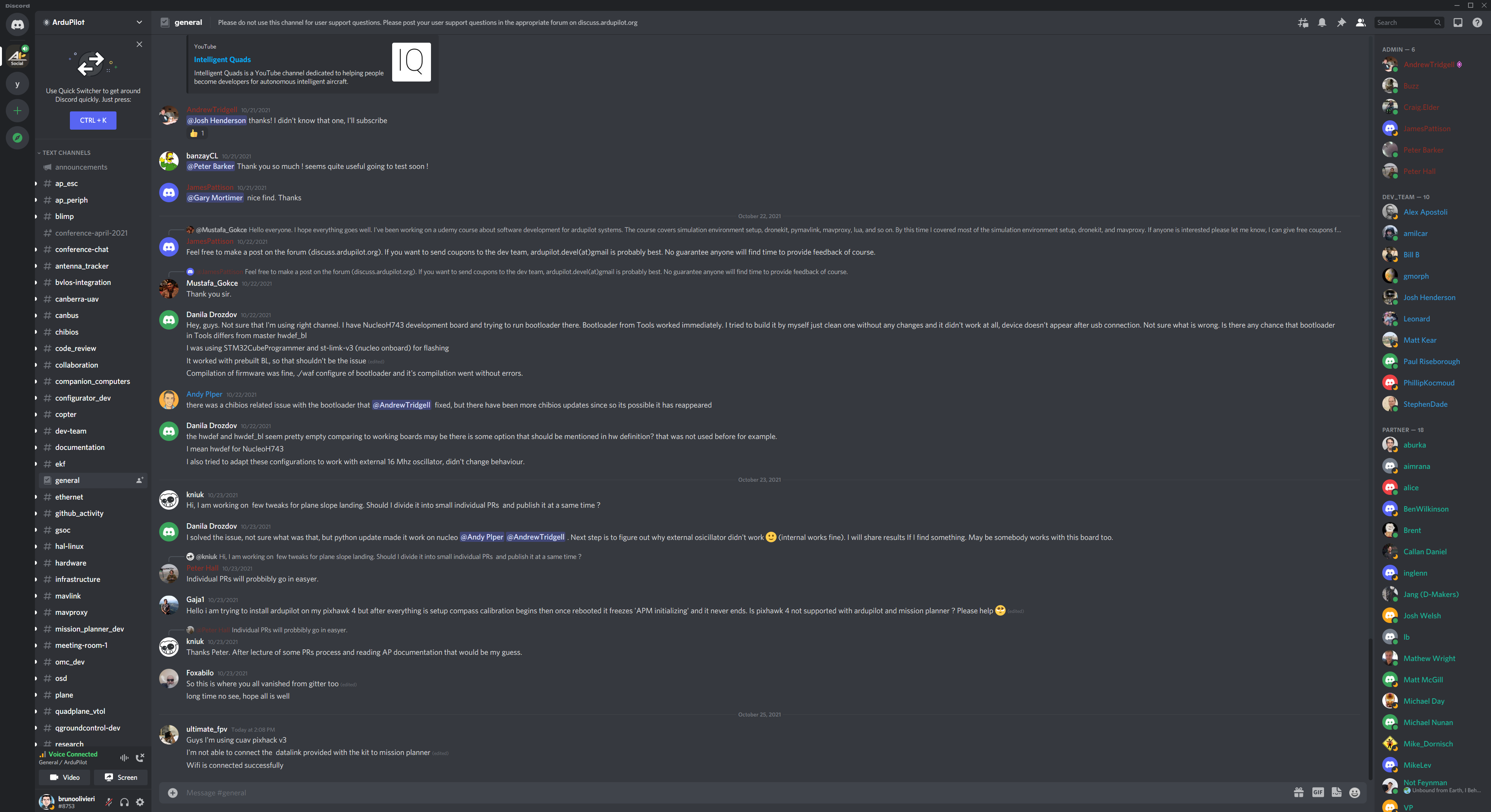
Discord
Developer Community
Working on the code? You can start with our Developers Guide and chat with other developers at our discord channels
One autopilot for any mission
ArduPilot enables the creation and use of trusted, autonomous, unmanned vehicle systems for the peaceful benefit of all. ArduPilot provides a comprehensive suite of tools suitable for almost any vehicle and application. As an open source project, it is constantly evolving based on rapid feedback from a large community of users. The Development Team works with the community and commercial partners to add functionality to ArduPilot that benefits everyone. Although ArduPilot does not manufacture any hardware, ArduPilot firmware works on a wide variety of different hardware to control unmanned vehicles of all types. Coupled with ground control software, unmanned vehicles running ArduPilot can have advanced functionality including real-time communication with operators. ArduPilot has a huge online community dedicated to helping users with questions, problems, and solutions.
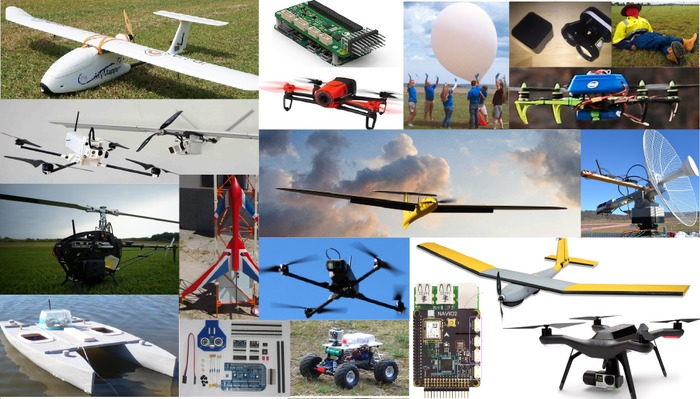
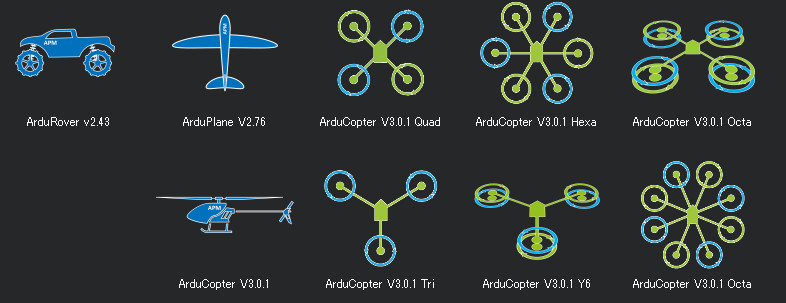
The ArduPilot Project provides an advanced, full-featured and reliable open source autopilot software system. The first ArduPilot open code repository was created in 2009 - since then it has been developed by a team of diverse professional engineers, academics, computer scientists, and other members of our global community. It is capable of controlling almost any vehicle system imaginable: conventional and VTOL airplanes, gliders, multirotors, helicopters, sailboats, powered boats, submarines, ground vehicles and even Balance-Bots. The supported vehicle types frequently expand as use cases emerge for new and novel platforms.
Installed in over 1,000,000 vehicles world-wide, and with advanced data-logging, analysis and simulation tools, ArduPilot is a deeply tested and trusted autopilot system. The open-source code base means that it is rapidly evolving, always at the cutting edge of technology development, whilst sound release processes provide confidence to the end user. With many peripheral suppliers creating interfaces, users benefit from a broad ecosystem of sensors, companion computers and communication systems. Since the source code is open, it can be audited to ensure compliance with security and secrecy requirements.
The software suite is installed in vehicles from many manufacturers, such as many from our Partners, and more broadly throughout the global autonomous systems industry. It is also used for testing and development by large institutions and corporations such as NASA, Intel and Insitu/Boeing, as well as countless colleges and universities around the world.
Terms & Slices
Unmanned vehicles
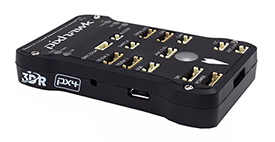
Hardware
Firmware
Software
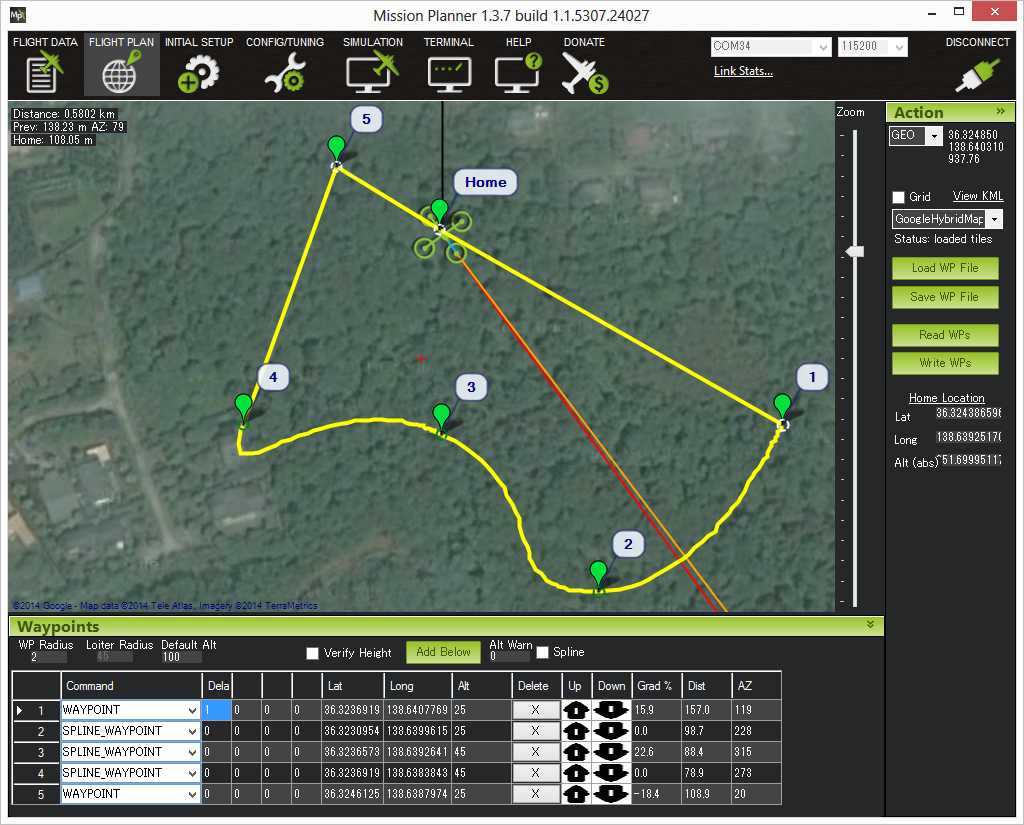
Ground Station
Mission Planner
ArduPilot Documentation
ArduPilot has a large set of documentation available through its Wiki. See the link DOCS in the top bar to check it. You need to choose your hardware (which you can get help in "AutoPilot Hardware"), then you could follow vehicle's "First Time Setup" for installing the firmware and Ground Station software, connecting the components, and calibration steps.